Captured: Santa coming into town on a motorcycle last Christmas.
‘Twas the night before Christmas, and all through the house, not a creature was stirring — except for one very desperate mouse.
Not the squeaky kind. The kind you’re currently using to scroll through this blog at this very moment. You see, my then 10-year-old sister Alexandra had finally had enough of the “If you stay awake for Santa, or if you catch a glimpse of him, all you’ll receive is coal!” nonsense. She wanted pixelated proof of his existence, at the bare minimum. My mom and stepdad delivered — at least to create one more year of magic. What they didn’t realize is that Alexandra didn’t need for him to be a real person to feel the magic.
—
Last Christmas Eve, my family was busy scurrying about the house to make sure all the last-minute gifts were wrapped, labeled and neatly nestled among the heaping pile of presents under our tree. As my mom and Russ were carrying the last batch of presents into our “Great Room,” I noticed the distraught expression on my sister’s face. Furrowed eyebrows. Eyes on the floor. Not the kind of behavior a child generally exhibits the day before Santa delivers nearly three-quarters of every circled toy from the kids’ Christmas catalogue.
Once her very obvious internal battle of wills was quashed, my sister reluctantly dropped a question that is, in general, almost as dreadful to parents’ ears as much as the shocking, “Where do babies come from?”
“Mom, dad, is Santa real?”
Oh, how I felt her pain. I, too, was 10 when my best friend told me — two weeks before Christmas — that it was actually mom and dad eating the chocolate chip cookies I’d worked so hard at baking just hours before his grand arrival. I tried to play it cool. “I always wondered how he got into the apartments without chimneys,” I told her nonchalantly. But you better believe all hell broke loose when I got home from school that day.
“You lied to me!” I yelled at my mom. “How can he not be real? You mean that time I wrote Santa a note telling him he was allowed to come to my room to see Bubble [my pet tree frog], but I swore I wouldn’t peek, and then he left me a note saying, ‘Dear Katie, thank you for the cookies. Also, I like your frog,’ — that was you!?”
I remember at that point, I was crying on the step outside of our garage. My mom looked at me, sighed, and sat down next to me. “Katie,” she said calmly. “He can still be real if you want him to be.”
I chewed on that for a minute. To me, the magic of the holiday had vanished. The morphine-like rush of Christmas spirit that used to surge through me at the first sign of my favorite time of year became weaker and weaker. Why? Because to me, Santa had become such an integral part of the holiday.
Fast forward again to Christmas Eve last year. My mom and Russ stood perplexed, not knowing if their faces had given away the truth before they even had a chance to move their lips. She interrupted their thoughts. “You would tell me if he didn’t exist, wouldn’t you?”
I’m not a parent, so I can’t say how I would react if my own child asked me if Santa were real hours before his jolly self were to arrive. Who wants to send a child to bed miserable, with her newfound knowledge that the red light outside her window she used to squeal about being Rudolph’s nose is really just that satellite tower blinking in the distance?
“Of course he’s real,” Russ told her.
“I want proof,” my hard-headed sister shot back.
“Isn’t believing in him proof enough?” he replied.
“No. Not anymore. I’m going to leave him a letter. You guys leave your camera out by the cookies.” And with that, she dropped the subject.
—
After Alexandra was tucked into bed, I crept up the stairs to my mom and Russ’ room and opened the door.
“Crap!” Russ whispered. “How do you get rid of the glare?”
“I don’t know! Try this one!”
The laptop was out. The fingers were frantically moving, and the camera was flashing. Google was going to make a believer out of my sister that night, but the Google Santas weren’t quite cooperating with our Sony Cyber-Shot.
“Might I ask why you’re doing this?” I asked as the shutter was going off. “Shouldn’t you have been, perhaps, honest with her?” I asked, eyebrows raised. It seemed, at the time, like a really backward thing to do, and one that would most certainly breed a certain degree of resentment and feelings of betrayal upon learning the devastating truth.
“She asked us on Christmas Eve, Katie.”
Yes, she did. I most certainly do not condone lying. But I also understand the awe and wonder a child feels when she knows that on that night, Santa is taking time out of his incredibly busy schedule to come visit her. What is a parent to do?
—
“EEEEEEEEE OH MY GOSH. Oh my GOSH. BOO YA! SEE?! He’s REAL! SANTA IS REALLLLL!!!” The cookies were gone, and the camera had the proof she needed. Santa was real.
Two weeks later, the truth was out. Was she okay with it? Nope. She tried to reject it just as much as I had. But I never heard about it from her. She stuffed it down and moved on. Besides, Christmas was over.
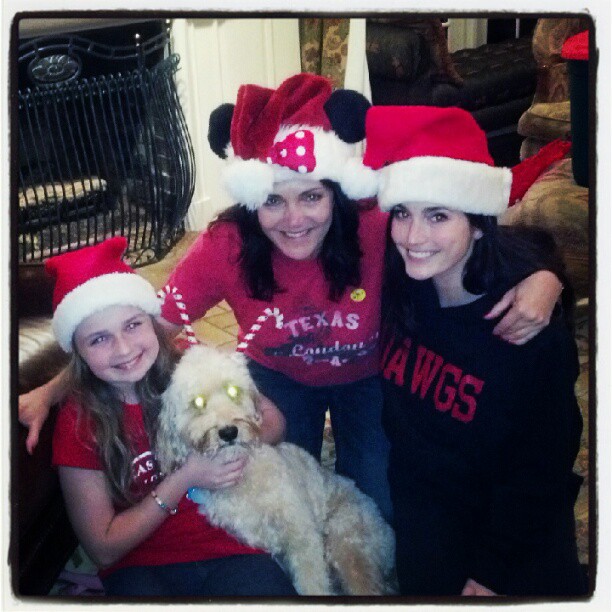
A couple of weeks ago, my family and I celebrated our annual tree decorating night with apple cider and Santa hats, as is custom. Mannheim Steamroller poured out of the speakers as Alexandra chased our terrified goldendoodle Sam around the house, trying to clip a Santa hat onto his head with bobby pins. Once Sam had been defeated, Alexandra re-joined us at the tree with a know-it-all look on her face.
“Whats up?” I asked her.
“You know, I don’t care what y’all say. Santa is real.”
She grinned. I realized that she did know the truth. But she didn’t let Santa cease to exist like I had. “He can still be real if you want him to be.” The words were said to me, but taken to heart by her. I had chosen to let the magic of Santa Claus die when I was 10… she hadn’t. Why? Because I saw Santa as I understood him. He was a real man who gave me presents every Christmas. Alexandra realized he stood for something else.
As a Christian, I understand the trepidation some parents feel about introducing Santa to their children as a living, breathing man — not the mall Santas — but the one who lives at the North Pole with his elves. If we tell our children he’s real for a number of years — even going out of our way to prove he is — and then shatter that belief, are we priming them to question their faith in other things, such as their Christian beliefs? If Santa was so real for so long, what’s stopping them from thinking that Jesus living in their hearts is also just a myth? Children look to their parents for truth. Catch them lying, and it undermines their credibility as a whole and makes them look at lying as a less serious offense.
I believe Santa represents many things — how you choose to celebrate with Santa each Christmas is your own choice. To some, Santa is simply a sign of commercialism. To others, he’s a sign of goodwill, or perhaps a celebration of Saint Nicholas and his charitable nature. Santa Claus in the physical sense may be a myth — there is no single, living individual who wears a red suit, dines on a diet of millions of cookies and spends his Christmas Eves chimney shimmying — but his purpose is real, at least to those who choose to understand his non-commercial qualities. Why not introduce him as a man who once lived (Saint Nicholas) whose values we continue to celebrate today, but still enjoy the fun of today’s story of the elves and reindeer and leave out the cookies anyway?
Santa represents the spirit of giving. He represents forgiveness — even the children who don’t behave like perfect angels still wake up surprised (even if they don’t recognize how blessed they are). He represents joy, peace and love. So even when children come to learn this man isn’t alive, it’s wonderful when they do choose to keep his purpose alive and make him a real part of their Christmases each year. Santa the man may not be coming down our chimney in two weeks, but that hasn’t dampened my sister’s Christmas spirit one bit. She’s choosing to keep Santa around this year.

It’s back to the North Pole.





 KATIE SIMON